Are Cavities Hard or Soft? What Tooth Decay Actually Feels Like
If you run your tongue over a tooth and find a rough patch, a little dip or something that feels different from the rest, it's very easy to start wondering if you've found a cavity.
But here's the slightly strange thing about tooth decay: a cavity isn't necessarily soft, and a dark mark isn't necessarily decay.
What a dentist sees is only part of the story. We also want to know what's happening to the structure of the tooth, how the area has changed and whether the decay appears to be active.
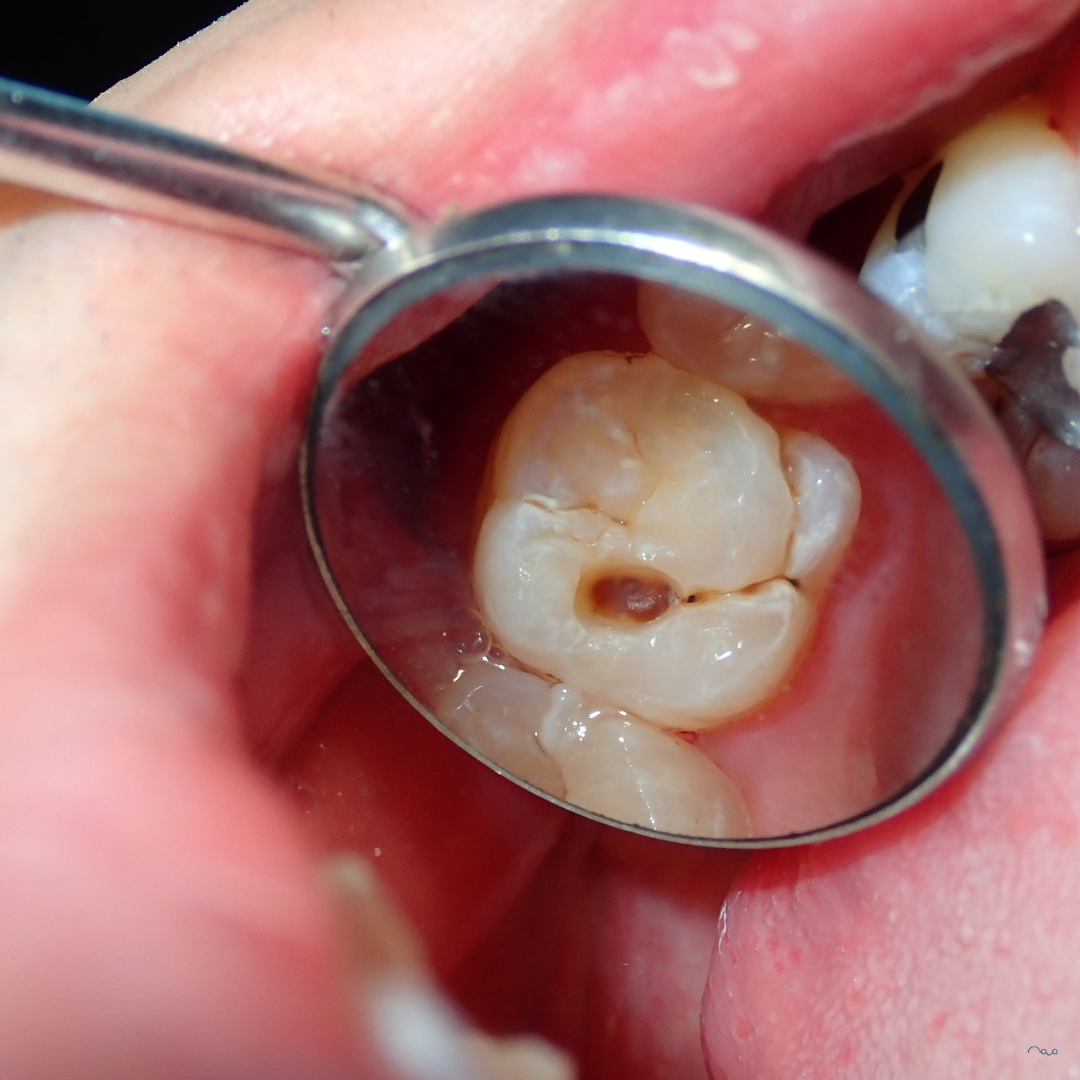
Tooth decay doesn't start as a hole
It's easy to picture a cavity as a little hole gradually being drilled into the tooth by bacteria.
The early stages are much less dramatic.
Enamel is incredibly hard and highly mineralised. When acids produced by bacteria repeatedly attack it, minerals begin to leave the surface in a process called demineralisation.
At this point, the tooth may still feel completely hard. You might see a chalky or white area on the enamel, but there isn't necessarily a hole you could feel with your tongue.
This stage matters because early demineralisation doesn't always need a filling. If the surface hasn't physically broken down, improving plaque control, reducing the frequency of sugar exposure and making sure the tooth has enough fluoride can help tip the balance back towards remineralisation.
In other words, catching decay early can make a very real difference to what happens next.
So when does a cavity become soft?
Underneath enamel is a layer called dentine.
Dentine is naturally softer than enamel and has a very different structure. Once decay progresses through the enamel and reaches this layer, the affected tooth structure can become softer or leathery.
That's one of the things a dentist is assessing when examining a suspicious area.
We're not simply thinking, "There's a brown mark, so that's a cavity." We're looking at the location, shape and appearance of the area, the condition of the surrounding tooth and, where appropriate, what the affected tooth structure feels like.
That distinction matters because two dark areas can look quite similar in the bathroom mirror and be doing very different things.
A dark spot isn't automatically an active cavity
This is where things get interesting.
People understandably associate black or brown marks on teeth with decay, but colour isn't enough to diagnose a cavity.
The grooves on back teeth can pick up staining from food and drinks while the enamel underneath remains perfectly hard. There is also something called arrested caries, where an area of previous decay is no longer actively progressing. Arrested areas can actually look quite dark.
If the conditions in the mouth improve, for example through better plaque control, fluoride exposure and changes to eating habits, an early lesion can become inactive. The surface may become hard again even though the discolouration remains. So a darker tooth isn't necessarily a "worse" tooth.
This is also why looking at a photograph at home and trying to decide whether a mark is staining or decay can be surprisingly difficult.
Can you feel a cavity with your tongue?
Once a cavity has physically changed the shape of a tooth, you may be able to feel it.
Your tongue is remarkably good at detecting tiny differences. A rough edge, dip or hole that wasn't there before can feel enormous when you keep running your tongue over it.
But there's an important limitation.
By the time you can physically feel a hole, the process may already have progressed beyond the earliest stage. Decay between two teeth can also develop without creating anything your tongue could possibly detect. That's why "I can't feel anything wrong" isn't a particularly reliable cavity test.
What if there's a hole but it doesn't hurt?
This catches people out too; a cavity doesn't have to hurt.
The outer parts of a tooth don't contain the same nerve tissue found in the centre, so decay can progress through enamel and into dentine without producing the sort of toothache that immediately gets your attention.
Pain tends to become more concerning as the pulp, the living tissue containing the tooth's nerves and blood vessels, becomes irritated or infected.
That's why waiting for toothache before getting something checked can mean waiting considerably longer than you'd want to.
If you've noticed a hole, a new rough area or food suddenly getting caught in a tooth, it's worth mentioning even if it feels completely comfortable.
Why dentists don't diagnose decay by sight alone
There are plenty of things we can see during a dental examination, particularly with good lighting and magnification. But the visible surface of a tooth doesn't tell us everything.
Decay often develops between teeth, where you can't see it in the mirror and a dentist may not be able to view the full extent directly either.
That's where X-rays become useful. They can show changes beneath and between the visible surfaces and help us judge how far decay has progressed.
It also explains why sending Nova a photograph can be a useful starting point, but there are limits to what can be diagnosed remotely. A photograph might show an area worth investigating, but if we need to know what's happening inside or between the teeth, an examination or X-ray may be necessary.
Can early tooth decay actually be reversed?
This depends on what we mean by "decay".
Very early mineral loss in enamel can be stopped and remineralised before a physical cavity develops. Fluoride is particularly useful here because it helps strengthen the enamel and makes it more resistant to future acid attacks.
Once tooth structure has actually broken down and a hole has formed, however, the situation is different. Lost tooth structure doesn't simply grow back.
This is why dentists care so much about finding changes early. There's a significant difference between helping an early lesion become stable and waiting until enough tooth has been lost that it needs restoring.
So, are cavities hard or soft?
The answer is: they can be either, depending on what's actually happening to the tooth.
Early enamel demineralisation can still feel hard. Active decay that has progressed into dentine can become softer. An old, inactive area of decay may be dark but hard. A perfectly innocent stain can be dark too.
That's why trying to diagnose a cavity based on colour, texture or pain alone isn't particularly reliable. Dentists put those clues together with the location of the mark, the condition of the rest of the tooth, your symptoms and X-rays when they're needed.
If you've found something new with your tongue or spotted a mark that wasn't there before, you don't need to work out what it is yourself. Get it looked at while it's still a small question rather than waiting for toothache to provide the answer.