Waterpik vs Philips Sonicare Water Flossers: Full Comparison Review
Medically reviewed by Dr Zaeem Jafri BDS on 13th March 2026
If you’ve ever stood in a pharmacy aisle staring at dental gadgets and wondering why on earth a jet of water needs its own shelf, you’re not alone. Water flossers have gone from niche to must-have in just a few years, and two names dominate the conversation: Waterpik and Philips Sonicare. Both promise cleaner gums, fresher breath and fewer lectures from your dentist. But which one actually delivers the best results? And more importantly, which one’s right for your bathroom shelf?
We’ve taken a deep dive into both brands, tested their flagship models, and compared them across power, usability, design, price, and overall cleaning performance. Here’s everything you need to know before buying your next water flosser.
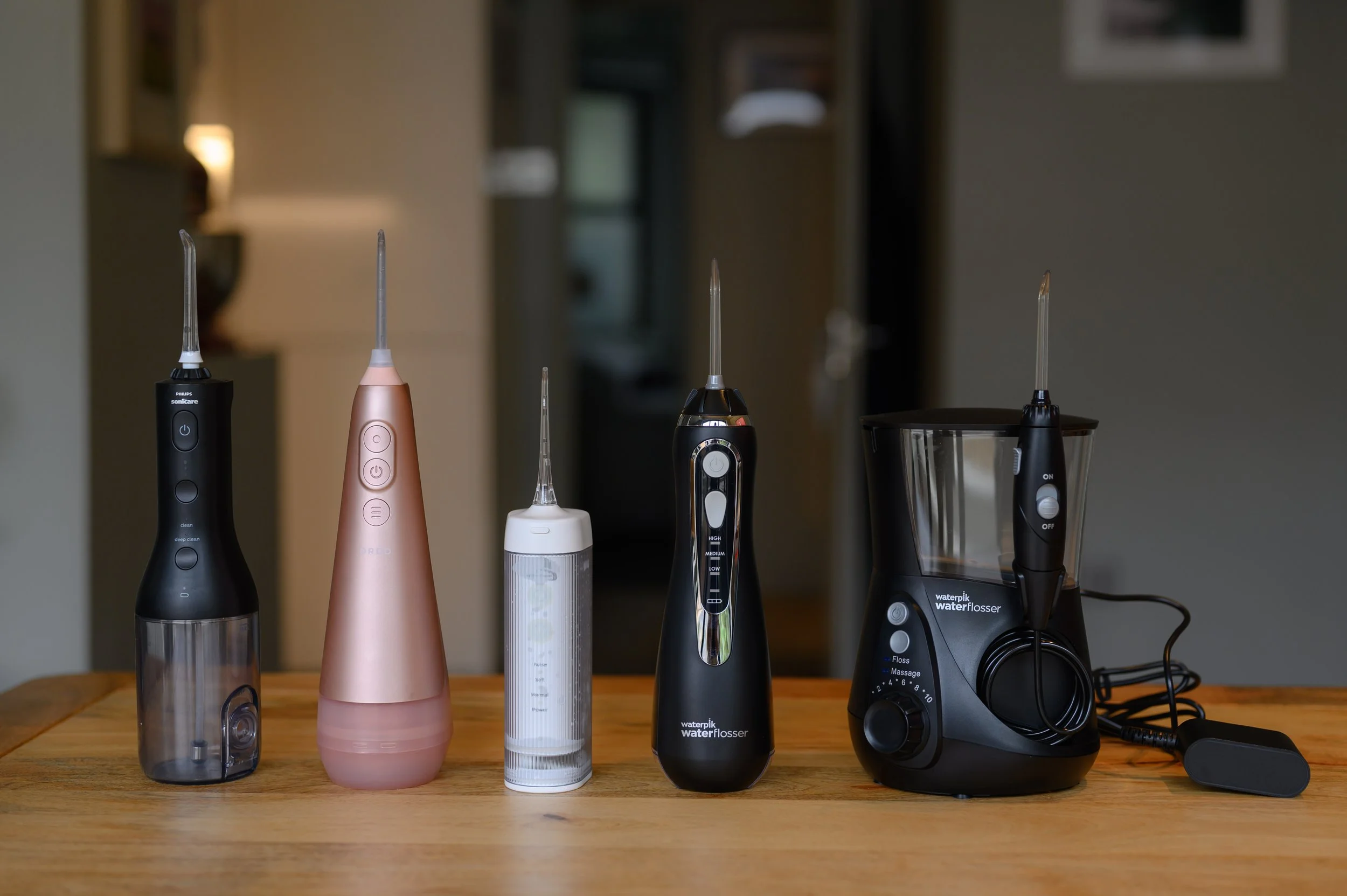
Some of the waterflossers we have tested
How Have We Tested These Water Flossers?
The water flossers featured on this page have all been tested by Dr Zaeem Jafri, our founder and expert dentist. And are a result of personal opinion.
None of the water flossers featured on this page are going to be bad for your teeth and gums, but they will all have individual characteristics that suit certain people, and our goal is to help you understand what might be right for you.
Key features we have considered
Cost
Cleaning power
Ease of use and space required
Travel Features
What Is A Water Flosser?
Still a bit unsure as to what a water flosser actually is? It’s essentially a motorised, highly-focused stream of water that you can fire in the gaps between your teeth to effectively blast away plaque. Designed with thin nozzles that can easily move around your gums, it blasts away leftover food, as well as clearing away plaque build-up between braces to give you a clean that isn’t possible with just an electric toothbrush. It’s different to the traditional string floss, which you must use manually, and can be more effective at blasting away plaque from between your teeth.
What’s the difference between Waterpik and Philips Sonicare?
At first glance they look similar. Both shoot controlled pulses of water between your teeth and along the gumline to blast away debris and plaque. But they take slightly different approaches.
Waterpik has been doing this for decades and focuses on strong pulsation and water pressure. The brand’s devices often feel more powerful because they’re built around classic jet stream technology.
Sonicare, on the other hand, is better known for sonic electric toothbrushes. Its water flossers tend to use air and micro droplet tech alongside the water stream, aiming for a gentler but still deep clean.
Think of Waterpik like a pressure washer for your mouth, while Sonicare is more like a precision sprayer that’s a bit kinder if your gums get sensitive easily.
Waterpik vs Sonicare: Product comparison
Let’s break down the standout products from both brands.
Waterpik Ultra

This is Waterpik’s best selling countertop model and for many people it’s the gold standard. It’s certified by the American Dental Association, which always adds a bit of confidence if you care about clinical backing.
Highlights:
Ten pressure settings
Large water reservoir
Several specialised tips (orthodontic, plaque seeker, classic jet and more)
Pulse modulation technology for improved gum stimulation
The WP 660 is powerful, easy to use and brilliant if you wear braces or have bridges. The tank is big enough for a thorough clean and it’s the one model we’d recommend to people who want dentist level results at home.
Philips Sonicare Power Flosser 3000

This is Sonicare’s most popular model and the one most often compared to Waterpik’s heavy hitters. It uses Quad Stream technology, splitting the water into four thin streams for quicker coverage with less manual aiming.
Highlights:
Two cleaning modes and up to ten intensities
Compact countertop unit
Quad Stream nozzle for broad cleaning
Pulse Wave function to guide your movement along the gumline
The Power Flosser 3000 feels very polished. It’s sleeker than most Waterpik units and quieter too. The cleaning is gentler but still effective, especially for beginners or people prone to gum tenderness.
Cleaning performance comparison
Let’s get to the part everyone actually cares about.
Waterpik’s cleaning power
Waterpik is known for power, so if you’ve got tight contacts, braces, implants or lots of food trapping, you’ll appreciate the pressure. Even on medium settings, the jet cuts through plaque quickly and leaves your mouth feeling incredibly fresh. It’s also brilliant for flushing out stubborn areas behind molars.
Some people find the learning curve a little messy, and many report light bleeding on first use, but after a few cleaning sessions, that should ease. Once you master it though, the results speak for themselves. If you want the deepest clean possible, Waterpik usually wins.
Sonicare’s cleaning power
Sonicare’s approach is more refined. The Quad Stream nozzle sends four thin jets around the tooth, which is excellent for covering more surface area with less effort. The Pulse Wave feature gently prompts you to move along the gumline, making your technique almost fool proof.
The cleaning is less intense than Waterpik’s, but for people with sensitive gums or mild periodontal concerns, it feels more comfortable. It also tends to be less splashy for beginners.
Ease of use and design
Waterpik consistency and control
Waterpik’s controls are straightforward. Countertop units offer a full range of pressure settings, while cordless ones keep it simpler with three modes. The design is functional rather than stylish, but everything works reliably and is built for long term use.
Sonicare style and simplicity
Sonicare wins if you care about aesthetics. Their devices look modern, streamlined and more in line with high end grooming tech. They’re also very intuitive. The Quad Stream nozzle reduces the need for precision and the controls are minimal.

Water flossing can eliminate plaque between your teeth, giving you a cleaner, healthier smile
Noise levels
Waterpik is louder, especially the countertop units.
Sonicare is noticeably quieter. If you share a flat or brush at odd hours, that might matter more than you think.
Price comparison
Waterpik pricing
• Waterpik Aquarius WP 660 usually sits around mid range pricing
Sonicare pricing
• Sonicare Power Flosser 3000 tends to fall in the same mid range bracket
The prices fluctuate depending on sales and bundles, but overall both brands sit within a similar bracket. Waterpik sometimes offers better value because of the number of tips included.
Best water flosser for braces
Waterpik wins this without question. Their orthodontic nozzle is designed specifically for brackets and wires, and the strong pressure dislodges plaque far better than Sonicare’s gentler system.
Best for sensitive gums
Sonicare takes it. The Quad Stream design means the water is dispersed enough to avoid discomfort, and the lower intensity options are easier to tolerate.
Best for beginners
Sonicare is generally easier to master. The wide spray covers more area, the controls are simple and the whole process is less of a learning curve.
Best for deep cleaning and gum health
Waterpik wins, especially with the Aquarius model. The ADA seal and the strong pressure options make it a favourite among dentists for patients with gum disease or heavy plaque buildup.
Is It Safe To Replace String Floss?
Dentists still recommend string floss for contact areas, but many agree that water flossers are excellent additions, especially if you struggle with flossing or have gum disease. Many patients do use them as their main method, but it depends on your mouth and your dentist’s advice.
How Often Should You Water Floss?
Once a day is ideal. Morning or night doesn’t matter, as long as you make it a habit.
Final Verdict: Waterpik Or Sonicare?
There’s no one size fits all answer, but here’s the simplest way to decide.
Choose Waterpik if you want: The strongest clean available
• The best option for braces, implants or bridges
• Maximum plaque removal
• Lots of pressure settings
• A clinically proven system backed by decades of research
Choose Sonicare if you want: A gentler clean
• A quieter machine
• A sleek, modern design
• A beginner friendly setup
• A wider spray that doesn’t require perfect technique
For most people, Waterpik still takes the crown for overall cleaning performance. But Sonicare is the better choice for comfort, ease and stylish bathrooms. Regardless of which one you choose, just make sure you stick to a consistent routine.