What Does a Dental Hygienist Actually Do for Your Teeth?
If you brush twice a day, clean between your teeth and don't have any obvious problems, it's reasonable to wonder what a dental hygienist is going to do that you're not already doing yourself.
Quite a lot, as it turns out.
A hygienist appointment is often associated with getting your teeth professionally cleaned and leaving with them feeling noticeably smoother. That's certainly part of it, but it's not really the main reason we want people to see a hygienist.
The bigger job is looking after the foundations that keep your teeth healthy in the first place: your gums, the bone supporting your teeth and the areas where plaque and tartar tend to build up despite your best efforts at home.
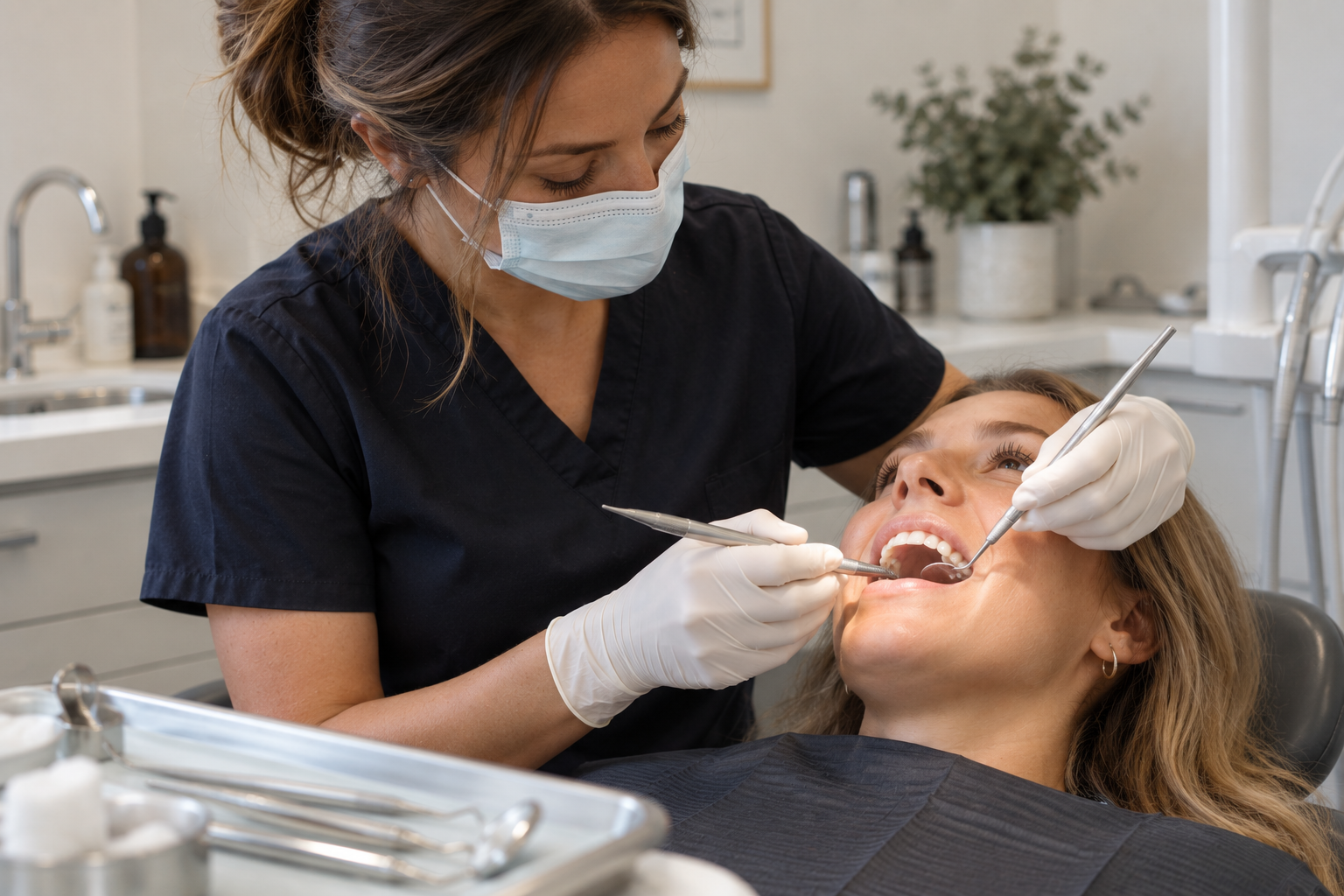
What does a dental hygienist do?
A dental hygienist's main focus is preventing and treating gum disease and helping you keep your mouth healthy between dental appointments.
That usually involves assessing the health of your gums, looking for areas of inflammation or bleeding and removing deposits of plaque and tartar from around the teeth and gumline.
They'll also look at how you're cleaning your teeth at home. Not in a schoolteacher-with-a-red-pen sort of way, but because mouths are surprisingly individual.
Crowded teeth, bridges, implants, receding gums and the size of the spaces between your teeth can all affect the best way to clean them. A hygienist can show you which areas you're consistently missing and which brushes, floss or interdental brushes will actually work for your mouth.
Why can't I just remove plaque myself?
You can, and that's exactly what we want you to do.
Plaque is the soft, sticky film of bacteria that continually forms on your teeth. Good brushing and cleaning between your teeth disrupts it before it has much opportunity to cause trouble. The difficulty comes when plaque isn't removed thoroughly and begins to harden into calculus, also known as tartar.
Once it's hardened, your toothbrush can't simply brush it away. It needs to be professionally removed.
Tartar also creates a rough surface that makes it easier for more plaque to collect, particularly around the gumline. This can contribute to the inflammation that leads to bleeding, swollen or tender gums.
So the hygienist isn't replacing what you do at home. Your daily cleaning is doing most of the work. The hygienist is dealing with what has accumulated despite it and helping you stop the same areas being repeatedly missed.
What does gum health have to do with keeping your teeth?
Quite a lot.
When we talk about looking after teeth, it's easy to concentrate entirely on cavities, fillings and enamel. But every tooth relies on healthy gums and supporting bone to stay where it is.
The earliest stage of gum disease is gingivitis. You may notice that your gums look redder than usual or bleed when you brush or clean between your teeth.
At this stage, the inflammation can usually be reversed with effective plaque removal and improved cleaning.
If gum disease progresses to periodontitis, the tissues and bone supporting the teeth can begin to be damaged. Unlike early gingivitis, that loss of support isn't simply reversed by brushing a little better for a few weeks.
This is one reason hygiene appointments can be such an important part of preventive dentistry. We'd much rather help keep those supporting structures healthy than wait until a tooth itself starts to feel loose.
But my gums don't bleed. Do I still need a hygienist?
Possibly, although there isn't one hygienist schedule that suits everybody.
Some people naturally build up tartar more quickly than others. Some have areas that are difficult to reach because of the position of their teeth. Smoking can also make gum disease harder to spot because it can reduce some of the obvious signs such as bleeding.
Existing gum disease, implants, bridges and certain types of dental work can all change the level of maintenance you need too.
That's why you might know somebody who sees their hygienist every three months while somebody else goes much less frequently.
The useful question isn't really, "How often should everyone see a hygienist?"
It's, "How often does my mouth need it?"
Your dentist or hygienist can recommend an interval based on your own gum health and risk rather than putting everybody on the same timetable.
What happens at a dental hygienist appointment?
Your hygienist will usually start by looking at your teeth and gums and assessing where plaque, tartar, bleeding or inflammation is present.
Depending on what your mouth needs, they can then remove plaque and hardened tartar using professional instruments. Teeth may also be polished to remove some surface staining and leave the surfaces smoother.
If you have signs of gum disease, the appointment may involve more extensive cleaning around or below the gumline.
But one of the most useful parts happens before you leave the chair.
A hygienist can see exactly where plaque is accumulating in your mouth. If the same area is being missed every day, simply telling you to "brush better" isn't particularly helpful. Working out why you're missing it and changing your technique is.
That's the part that carries on working long after the appointment is over.
Does a hygienist whiten your teeth?
Not in the same way as professional tooth whitening.
A hygiene appointment can remove some external staining caused by things such as tea, coffee and tobacco. That can make the teeth look brighter because you're revealing the natural tooth surface underneath.
Whitening is different. It changes the colour of the teeth themselves using a whitening agent.
So if your teeth look darker because they're covered in surface staining, a professional clean may make a noticeable difference. If the natural colour of the tooth is what you want to change, you'd need to look at whitening instead.
Do you still need a hygienist if you're good at brushing?
Being good at brushing is an excellent start. It doesn't necessarily mean every surface of every tooth is being cleaned equally well.
Most of us have favourite areas without knowing it. We start in the same place, hold the brush in the same hand and follow roughly the same route every morning and evening.
That makes it remarkably easy to be very good at cleaning 90% of your mouth while repeatedly neglecting the same 10%.
A hygienist has the advantage of being able to see your mouth from an angle you never can.
If they keep finding plaque behind one particular tooth or inflammation in the same area, that's useful information. You can change what you're doing rather than simply spending longer brushing everywhere else.
A healthy mouth starts with healthy foundations
There are plenty of things modern dentistry can do once a tooth needs repairing or replacing. But keeping your own teeth healthy for as long as possible is still the aim.
That doesn't begin with fillings, crowns or implants. It begins with controlling plaque, keeping the gums healthy and spotting changes before they become bigger problems.
Your toothbrush and interdental cleaning do most of that work every day. Regular dental examinations keep an eye on the health of your teeth and mouth. And when you need it, your hygienist provides another important part of that preventive care.
It may not be the most glamorous side of dentistry. But if you want to keep your teeth for the long haul, looking after what holds them in place is a very good place to start.